
St. Tammany Release Date Meaning
A projected release date is an agency calculation of when a sentence may reach a release point if the facts used in the calculation stay the same. It is prospective, which means it looks ahead. The actual release date records when a custodian ended its control of the person. Those dates can differ. A court may amend the commitment papers. Another sentence may be added. Disciplinary action may affect earned credit, or another agency may place a hold. A parole decision can also alter the path without proving that the person walked out that day.
Custody type matters just as much. Someone awaiting trial at the St. Tammany Parish Correctional Center has not reached a sentence-based release calculation. Bond, a court ruling, and unresolved holds control that case. A person serving a parish sentence may have jail credit and a local or state computation. An LDPSC prisoner has a state calculation based on the signed sentence documents. A parole-eligibility date only marks a point when consideration may be allowed. It is not an assured exit date.
When the distinction matters, preserve the label used by the source. “Projected release date,” “parole eligibility,” “sentence expiration,” and “date of discharge” answer different questions. Do not convert one label into another.
Find a St. Tammany Release Date
Start with the signed judgment and the authority that now holds the person. Louisiana does not provide a conventional public website where any name produces a full historical LDPSC profile and dependable projected-date field. The public state paths are LAVNS/VINELink and the automated LDPSC Imprisoned Person Locator. Parish cases also require the jail and 22nd Judicial District Court records. A missing name on the current jail roster does not show where the person went.
How to Find a Projected Release Date
- Identify the custody. Confirm whether the person is at the St. Tammany Parish Correctional Center, in LDPSC custody, or held by another authority. Match the full name with a date of birth, booking number, DOC number, or court docket when available.
- Get the court papers. Obtain the signed sentencing minute or judgment from the St. Tammany Clerk. Check jail credit, offense date, sentence length, and whether terms run at the same time or one after another.
- Use the correct agency route. For a parish case, ask STPSO or the court about the recorded custody event. For a state prisoner, call the LDPSC locator with the DPS&C number or the person’s name and date of birth.
- Record the exact date label. Ask whether the answer is a projected release date, eligibility date, sentence expiration, or final discharge date. Keep the source agency with the date.
- Check for changes. Ask whether updated court papers, another sentence, a detainer, discipline, or a parole action has affected the current calculation.
- Confirm after processing. Recheck near the expected date. For a parish release, use the STPSO release entry or requested custody chronology rather than a guessed time.
For a wider named-person search and the difference between a parish release, a state discharge, and a transfer, use the St. Tammany Parish released-inmate search paths. That broader record check helps prevent a state transfer from being misread as a return to the community.
Note: A court calendar shows what is scheduled, while the signed minute or judgment supplies the sentence terms used in a computation.
LDPSC St. Tammany Release Dates
The LDPSC Locate Imprisoned Person instructions direct the public to an automated telephone locator at 225-383-4580. A caller supplies either the DPS&C number or the person’s name and date of birth. The service can provide the facility assignment, facility address, facility phone number, and a “projected release date, if applicable.” The words “if applicable” are important. A projected date may not exist for every record, and the output is not a final discharge certificate.
The official locator page shows the scope of this state route:
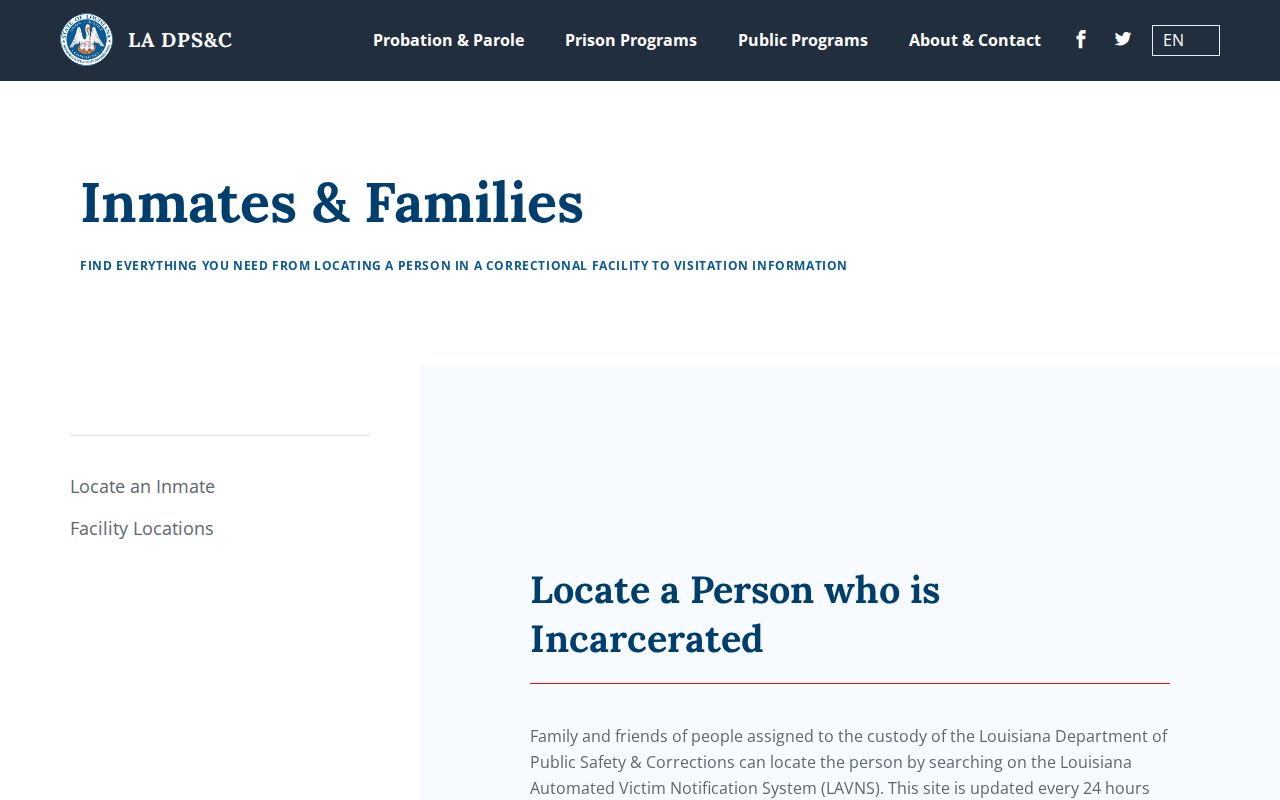
That official screen supports the phone workflow instead of a made-up browser result. LAVNS/VINELink can supplement the call by showing the reporting agency and current custody status, but the source must be read with care. A St. Tammany Parish Jail result concerns the parish booking. An LDPSC result concerns state custody. “Out of custody” means the named source ended its reported custody; it does not by itself identify the next destination.
If historical confirmation is needed, Louisiana law permits a focused request for certain public general information, including the date of discharge. Full corrections files remain confidential. Ask for the discharge date and the other public general information described by R.S. 15:574.12(G)(1)(a), not the complete institutional file. A final discharge date looks backward and can confirm what occurred. A projected release date looks forward and can still change.
St. Tammany Sentence Paperwork Delay
LDPSC cannot calculate a newly sentenced person’s release date until the sentencing court’s official paperwork arrives. The LDPSC calculation explanation makes that prerequisite clear. A verbal sentence in court, a news report, or an early docket note may omit details that the final computation needs. The signed commitment must show the offense, term, jail credit, and sentence structure with enough precision for the agency to apply the correct law.
The official FAQ capture documents that gap:

The lag explains why a new state sentence may not yield an immediate answer. First obtain the signed St. Tammany Clerk minute or judgment. Then confirm that LDPSC received it. If the court later corrects the commitment or jail-credit figure, ask whether the revised paper reached the computation unit. Send public-record requests to the records office only for existing releasable records. LDPSC states that sentence-computation questions do not belong in the public-records inbox.
Consecutive and concurrent are key terms. Concurrent sentences run at the same time. Consecutive sentences run one after another. A simple sentence-length count that ignores this choice can be far wrong, even before earned credit, exclusions, or later court action are considered.
Louisiana Good Time Release Rules
Louisiana calls good-time reduction “diminution of sentence.” It can reduce the custodial term for an eligible person, but there is no sound universal formula for a St. Tammany Parish inmate. The offense date selects which law applies. The offense type, sentence, exclusions, court-awarded credit, discipline, and program rules then shape the result. LDPSC has the authority to calculate accrual. A private estimate based only on the sentence length should not replace that calculation.
For eligible felony offenses committed on or after August 1, 2024, R.S. 15:571.3.1 provides ordinary diminution of up to fifteen percent of the sentence imposed. The common 85-percent shorthand is therefore a cap-based summary, not a promise. The basic rule excludes defined sex offenses and habitual-offender sentences. Presentence jail credit does not earn good time under that provision, and forfeiture may reduce credit. Earlier offenses remain under the materially different structures in R.S. 15:571.3.
Other statutes add layers. R.S. 15:571.4 governs forfeiture and restoration, including disciplinary consequences. R.S. 15:828 authorizes rules for eligible program credit and allows up to ninety days for satisfactory participation in an approved program, subject to the statute’s limits. These provisions are reasons to request the current official date, not reasons to build a home calculation.
Note: “Good time” is earned statutory credit, while “time served” describes custody credit or completion under the actual judgment.
Why St. Tammany Release Dates Change
A date can move because the legal record or the person’s custody facts change. Some changes affect the sentence calculation. Others affect whether the person can leave the present facility. The agency must apply each valid paper or hold before release, so a date quoted early in the sentence may not match the final result.
| Change | Effect on the release path |
|---|---|
| Corrected court papers | An amended term, jail-credit figure, or sentence structure requires a new calculation. |
| Good-time forfeiture or restoration | Discipline can remove credit, while an authorized restoration can alter the balance again. |
| Approved program credit | Eligible, verified participation may affect the projected date within statutory limits. |
| New sentence or court order | Another judgment, revocation, or order may extend, shorten, or restructure custody. |
| Detainer or agency hold | The current custodian may release the person to another authority rather than to the community. |
| Parole action | Eligibility, a hearing, and a grant are separate stages; conditions and an effective date can still apply. |
A detainer is a request or notice from another authority concerning custody. It can cause a person to leave STPSO or LDPSC control and enter another agency’s control. That departure is a release from the first agency, but not a community release. Likewise, a parole grant is a decision. Check the effective date and then verify the actual custody event.
St. Tammany Release Time Limits
St. Tammany has a distinct local operational limit. The STPSO Bond Office says it does not give release dates to the public. It provides date information to the detained person through a unit kiosk. Even when release is designated for a certain date, processing may occur at any point from 12:01 a.m. through 11:59 p.m. There is no promise of a release just after midnight.
This means a correct legal date still does not produce a pickup hour. Court action, identity checks, bond processing, property steps, and a search for other holds can take time. The jail’s Bond Office also has its own daily closure, but that office schedule should not be turned into a claim that all types of release stop at the same time. The sound approach is to wait for an explicit processed release entry or to obtain the jail chronology afterward.
A person may properly remain on the current roster for much of the designated day. Once processing is complete, the documented 48-hour release view is stronger evidence than a midnight assumption. If the entry has aged off that public window, ask STPSO Criminal Records for the booking and custody/release chronology, including the recorded date, time, authority, and destination agency if the event was a transfer.
Confirm St. Tammany Release Processing
Final confirmation should come from the custodian that ended its control. For the parish jail, look for an explicit release date and time in the STPSO release view. After that short display window, request the durable release entry or custody chronology. Pair it with the 22nd JDC minute when a bond ruling, dismissal, sentence, credit award, revocation, or other court event explains the legal authority.
For state custody, call the LDPSC locator again near the projected date and read the reporting agency in LAVNS/VINELink. A status alert can be useful, but it is not a certified record and may lag. Registration instructions for a specific person are available through the VINELink Release Check. If the source says “out of custody,” keep the source name and time with the result. Then check for parole supervision or another agency when the facts call for it.
- Projected release date
- The corrections agency’s current, conditional calculation of a possible sentence release point.
- Actual release date
- The date on which the named custodian records that its custody ended.
- Discharge
- The end of the identified custody or supervision obligation, as stated by the responsible agency.
- Parole eligibility
- The point when parole consideration may be allowed, not a promise of a hearing result or release.
- Detainer
- A notice or request from another authority that can change where the person goes next.
Keep each term attached to its source. That small step prevents a tentative date, a parole threshold, and a completed release from being reported as if they were the same fact.
Note: Recheck near the expected date because a valid calculation can change before the final custody event is entered.