
St. Tammany 72-Hour Release Limit
St. Tammany Parish does not publish an official rolling 72-hour release feed. Its locally documented public option is a 48-hour list reached through the STPSO bookings application. That source can cover the newest two days. It cannot, by itself, recover a person whose entry fell off during the older third day. A complete three-day check must join the public view with a durable jail record and, when relevant, the 22nd Judicial District Court file.
The difference matters. A rolling display removes entries as they age, but the public display period is not the same as the agency’s record-retention period. The exact refresh interval has not been published. Save the visible release date and time, source, booking number, and update marker when available. For a release near the edge of the display window, seek a direct record rather than assuming that a missing card means no release took place.
Check St. Tammany 72-Hour Releases
Build the three-day result in time order. First capture the newest entries from the official 48-hour view. Then identify the start and end of the missing third-day interval. A request framed around that narrow period is more useful than asking for every jail record tied to a common name. Match identity with the full booked name, date of birth when known, booking number, booking date, docket number, and charge context.
- Open the official STPSO release view and collect entries whose explicit release times fall inside the newest 48 hours.
- Write down the exact 72-hour start time and isolate the earlier 24-hour gap not covered by the public screen.
- Submit a focused STPSO request for the named person or for existing release entries in that missing interval, subject to the custodian’s available search method.
- Check the Clerk’s criminal case record for the matching docket and read minutes tied to the custody change.
- Check LAVNS, LDPSC, or another authority only when the facts suggest transfer or a different custody system.
A three-day search can begin with the same source as the St. Tammany Parish released last 24 hours check, but it cannot stop there. The final result should identify which portion came from the public jail view and which portion came from requested or court records.
St. Tammany 72-Hour Release Fields
Official descriptions of the STPSO application support photographs, booking details, bond or bail-out information, and a 48-hour released population. A three-day reconstruction uses some fields directly from the live view and asks the records custodian for the same core facts after an entry rolls off. Do not claim that a release reason is displayed unless the current interface labels one. A court minute may explain the legal event, while the jail chronology supplies the physical custody endpoint.
| Field | Role in the three-day check |
|---|---|
| Full booked name | Links the result to a person, but should be paired with a stronger identifier. |
| Booking or inmate number | Distinguishes the relevant custody episode and focuses an STPSO request. |
| Booking date and time | Separates a recent booking from an earlier event involving the same person. |
| Release date and time | Places departure from STPSO custody inside or outside the exact 72-hour interval. |
| Charges and bond data | Provides booking context, but does not prove dismissal, conviction, or completed release. |
| Release authority or destination | May distinguish community release from transfer when it exists and is releasable. |
The STPSO Public Records Center directory describes the official current-inmate and 48-hour release resource. The matched capture below shows the official bookings source that starts, but does not complete, the 72-hour inquiry.
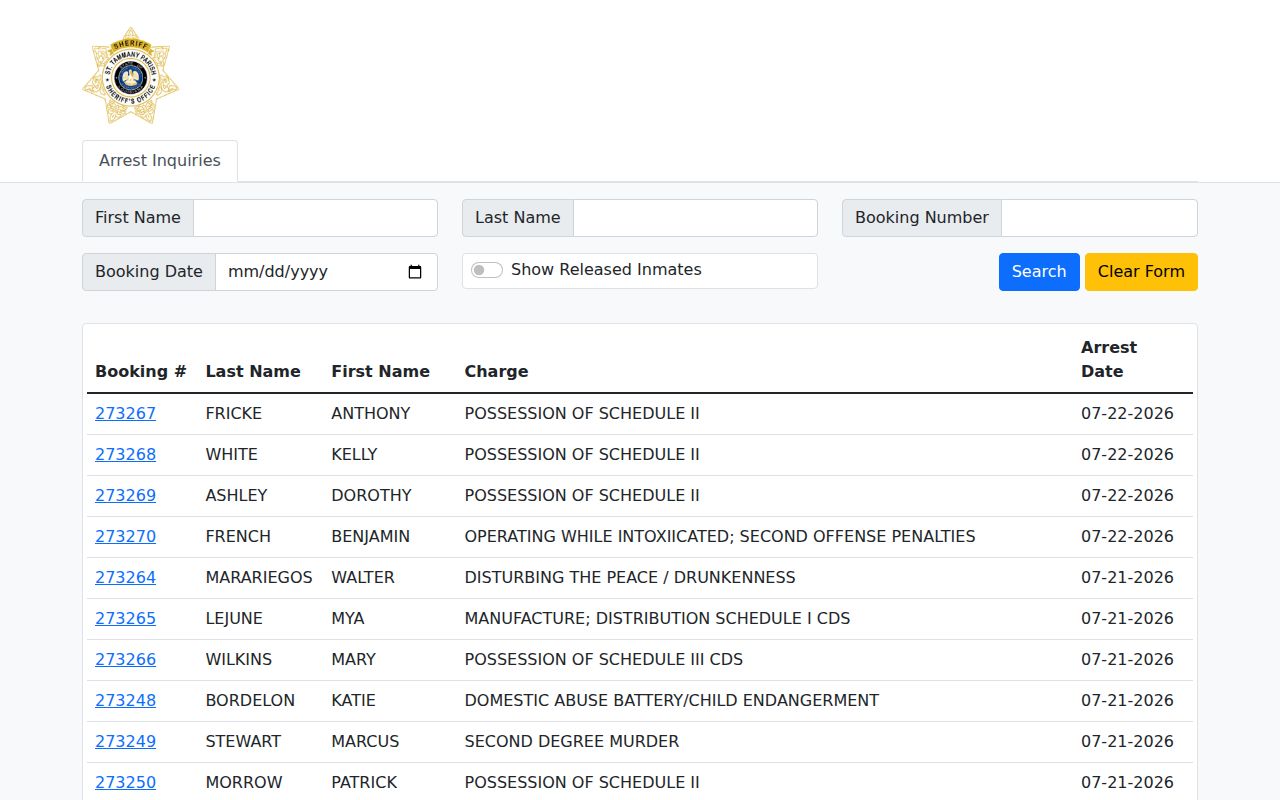
The older third day still requires the separate record and court steps. The image must not be read as a 72-hour feed.
Note: Preserve the displayed source time because a rolling St. Tammany Parish release entry can age off while the search is underway.
St. Tammany Weekend Release Window
A three-day window is most helpful when a search begins after a weekend or holiday. It reaches farther back than a same-day check, but St. Tammany’s public list still stops at the documented two-day span. The extra day must be rebuilt from existing agency and court records. Holiday scheduling can also shift court activity, so the 22nd JDC calendar is only a planning aid. It is not a record that a person was released.
Bond processing adds another distinction. The 22nd JDC Commissioner says qualifying arrestees have bond set within 24 hours, including weekends and holidays, while booking can take several hours. Bond setting does not mean the bond was posted, and posting does not mean release processing is complete. An explicit STPSO departure time or custody chronology remains the key local fact. For the case result, obtain the Clerk’s minute or judgment tied to that booking.
The STPSO Bond Office also notes that extraditions are not conducted on weekends. That operational point should not be expanded into a claim that every form of release stops. Other holds, transfers, paperwork, and verification can affect the sequence. Count the actual completed custody event, not a planned court or bond step.
St. Tammany’s 72-Hour Hearing
St. Tammany sources refer to a 72-hour hearing, but the hearing is a court and bond process. It is not a 72-hour release list. Court Intervention Services may screen eligible people in the two-parish jail system or those out on bond for voluntary service referrals, sometimes at that hearing. A hearing entry can show that a matter was scheduled or considered. It does not establish that STPSO opened the door at a certain time.
Keep each record in its lane. The court docket or minute documents judicial action. A bond order shows a condition of possible pretrial release. The jail release timestamp shows when STPSO custody ended. If another hold exists, the person may move to another custodian despite a favorable bond change. Never use the hearing schedule as a substitute for the Sheriff’s release record.
Recover St. Tammany’s Third Day
The older gap is best handled through STPSO Criminal Records. A focused request should include the full legal name and aliases, date of birth if known, approximate booking and release dates, and a booking, incident, or court number when available. Ask for the booking sheet, custody and release chronology, date and time custody ended, recorded release authority, and transfer destination if that existing field is public. State the desired electronic or paper format and whether certification is needed.
Requesting a narrow record reduces ambiguity. STPSO requires payment before release of responsive material, and its published fee schedule charges by record, page, image, media, and postage. Ask for an estimate before production when the scope is unknown. Louisiana Public Records Law governs access and agency response, but review, redaction, exemptions, record volume, and payment can affect timing. Do not promise that the missing third day will appear instantly.
The Clerk record is the parallel legal source. Search by docket number when possible, then look for minutes showing bond, dismissal, plea, sentence, time served, probation, revocation, or another order. A Sheriff’s release time and a Clerk minute complement one another. Neither should be made to answer the other office’s question.
St. Tammany Release Fallback Chain
LAVNS and VINELink can help confirm a custody-status event for a matching person and reporting agency. They are notification tools, not a complete archive of every St. Tammany Parish jail release across a chosen three-day span. Record the event wording, last update, and source agency. A St. Tammany jail result concerns parish custody. An LDPSC result concerns state custody. A no-hit does not prove release.
When state transfer or imprisonment is plausible, Louisiana directs the public to LAVNS and the LDPSC telephone Imprisoned Person Locator rather than a conventional historical web database. A state status is not the same as a parish-jail release. Federal and immigration cases also require their own tools. BOP, USMS, and ICE events should not be merged into an STPSO result merely because the person is no longer on the parish roster.
For one named person whose path may cross systems, the St. Tammany Parish released-inmate search provides the wider custody decision path. The 72-hour process stays focused on recent local departures and the records needed to restore the day the public list omits.
St. Tammany Release Versus Custody
Someone still listed on the live STPSO roster remains in the custody that roster reports. Someone with an explicit release date and time has left that reported custody. Neither roster absence nor a court hearing alone proves a community return. The person may have been released on bond, completed a sentence, left under court order, or transferred to LDPSC, another jurisdiction, federal authority, or immigration custody.
The reliable three-day result states only what each source supports. Cite the STPSO time for the end of parish custody. Use the requested release entry for authority or destination when available. Read the 22nd JDC or Clerk minute for the case event. Consult the next custodian’s system when transfer is plausible. That source-by-source method prevents the oldest day from vanishing and prevents a transfer from being mislabeled as release to the community.