
St. Tammany Parole Versus Probation
Parole is conditional release from imprisonment. The Louisiana Board of Pardons, Committee on Parole makes parole decisions, and the Louisiana Department of Public Safety and Corrections Division of Probation and Parole provides supervision. Probation is a sentence or status ordered by a court. The signed judgment and court minutes show whether the 22nd Judicial District Court imposed it. Release by diminution, often called release through earned sentence credit, may also lead to supervision under Louisiana law. Full discharge is different. It means the relevant custody or supervision duty has ended, though the conviction and court file may still exist.
A name missing from the St. Tammany Parish Correctional Center roster does not identify any of these outcomes. The person might have posted bond, moved to state custody, entered another agency's custody, or completed local confinement. Start with the sentence and the release authority. The parish release record proves when St. Tammany custody ended. The court record and LDPSC sources explain what came next.
| Point | Parole | Probation |
|---|---|---|
| Source | Conditional release from imprisonment | Court-imposed sentence or status |
| Decision record | Committee on Parole docket and decision | 22nd JDC judgment and minutes |
| Supervision | LDPSC Probation and Parole | The authority named in the judgment |
| End point | Parole discharge or sentence end | Completion, discharge, or court action |
- Parole
- Conditional release from prison before the full sentence expires, subject to stated terms.
- Probation
- A court-ordered status served under supervision instead of, or after, confinement.
- Discharge
- The formal end of a custody or supervision obligation.
- Absconder
- A supervised person alleged to have stopped reporting or left supervision without permission.
Verify St. Tammany Post-Release Supervision
Use several records because no single public St. Tammany Parish search shows every form of supervision. A parole docket can establish that a hearing was scheduled. It cannot prove a person left custody. A court minute can order probation, but it may not show the latest field-office status. LAVNS can report a custody event, yet it is not a certified supervision record. Matching the person by full name, date of birth, DOC number, booking number, and court docket avoids confusion between people with similar names.
- Read the judgment and minutes. Use the St. Tammany Clerk criminal record to identify probation, the sentence, revocation action, jail credit, or another order.
- Identify the custody authority. Check LAVNS or the LDPSC locator when a state sentence or transfer may apply. A parish roster absence is not enough.
- Check the parole source. Review the official Committee on Parole docket and decision only if the sentence makes parole relevant.
- Contact the supervision route. Give the local routing office the full identity, DOC number, and court docket when available. Ask which district office is responsible.
- Check warrants separately. Use STPSO Criminal Records for authoritative warrant verification. Do not infer a warrant from an old report or missing search result.
- Confirm the end status. Seek a discharge record or court entry rather than assuming that a term ended on an estimated date.
The full parish custody and court-record sequence is described on the St. Tammany Parish released inmates search. That route helps separate release from the jail from release into supervision.
Note: A supervision contact may route an inquiry without disclosing every detail contained in a protected corrections file.
St. Tammany Supervision Office Route
The STPSO corrections-resource directory publishes a local Probation/Parole routing number. No official public, person-level St. Tammany Parish supervision database or absconder list was found in the research sweep. The number is best used to locate the responsible LDPSC district office and ask how a status may be verified. It should not be treated as a promise that staff can release a complete case file over the phone.
Probation and Parole Routing
Agency: Louisiana Department of Public Safety and Corrections, Division of Probation and Parole
Local routing: 985-871-8351
State information: LDPSC Probation and Parole
Use: Identify the supervising district and request the available status-verification route.
For documentary proof, pair office confirmation with the sentencing judgment, later court minutes, and the proper LDPSC record. Louisiana R.S. 15:574.12 protects full corrections and parole files but identifies public general information, including date of discharge. A narrow request for that field is more accurate than asking for an unrestricted institutional file.
St. Tammany Parole Hearing Records
The Committee on Parole publishes hearing material through its current docket page. Dockets organize parole, pardon, and revocation matters by hearing week and agenda. Check the person's DOC number, facility, panel date, and type of matter. “Granted” can still carry conditions or a later effective date. “Denied” rejects release at that hearing. “Deferred” postpones action, while “rescinded” withdraws an earlier action. None of those terms alone proves physical departure from custody.
The official docket screen shows where Louisiana posts current hearing-week files. The image comes from the same Committee on Parole docket source.
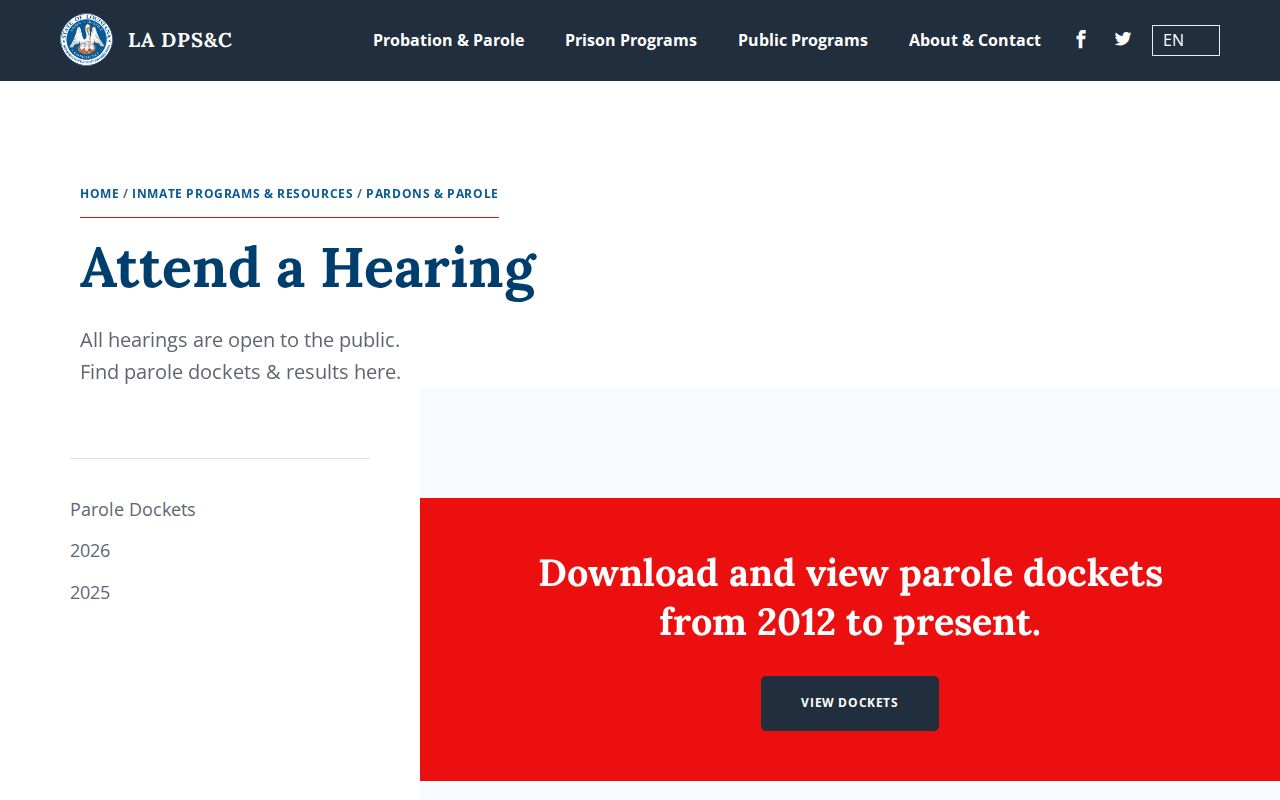
Use the published decision after the hearing, then verify custody through LAVNS or LDPSC after any effective date. A grant is not a jail release timestamp.
Important: Parole eligibility, a scheduled hearing, and a favorable decision are separate from an actual release and later supervision status.
St. Tammany Supervision Warrant Checks
A supervision violation is an alleged failure to follow a condition. An absconder allegation generally means the person stopped reporting or left supervision without authorization. Neither term proves that the person is now in jail. A warrant may exist while the person remains outside custody. Conversely, a person can return to custody for a reason unrelated to parole or probation.
Conditions depend on the judgment, release decision, and governing law. They can address reporting, travel, court-ordered programs, fees, contact limits, and compliance with the law. The actual written terms control. A claimed breach can lead to a report, warrant, hearing, modified terms, or revocation, but those outcomes should be read from the official record. Revocation means the supervising authority or court has formally withdrawn the conditional status after the required process. It should not be inferred from an arrest or custody alert alone.
STPSO states that Criminal Records houses warrants issued by the 22nd JDC and publishes 985-809-8242 for verification. Contact that office for a St. Tammany warrant question. The sentencing court record may show a motion, hearing, revocation, or later order. LDPSC Probation and Parole is the source for the supervision side when it can confirm releasable information. Avoid using an old press notice as current proof. Status can change after publication.
Note: A VINE custody alert may show a return to custody, but it does not explain the alleged supervision violation.
St. Tammany Release Reentry Referrals
The 22nd JDC's Court Intervention Services adds a local referral layer. Staff may assess people in the two-parish jail system or people out on bond for voluntary mental-health or substance-use services. An assessment may occur at a 72-hour hearing. Published eligibility includes parish residence and bond eligibility, with stated exclusions such as a Probation and Parole hold or fugitive status. This service route is not a custody or supervision lookup.
STPSO also documented a jail reentry program in an earlier budget for people committed to LDPSC custody. A later budget reports that two reentry positions were eliminated. Current staffing and access should therefore be confirmed before a person relies on the old program description. The useful distinction is simple: a service referral can support a return to the community, but only the court, custody, and supervision records establish legal status.
The 22nd JDC serves St. Tammany and Washington Parishes. A regional program reference does not mean that a person is held at a second St. Tammany facility. Verify the actual custodian first, then ask the current program contact about services. This avoids confusing a regional court service with a jail release record or supervision office.
St. Tammany Release Property Rules
Family logistics sometimes overlap with supervision planning. The STPSO offender-property page publishes a narrow process for releasing an incarcerated person's property to an authorized third party. It permits that process on Mondays from 10:00 a.m. to 6:00 p.m., requires a valid driver license or other ID, and says the public cannot add personal property.
This rule should not be recast as the routine property-return schedule for every person leaving the St. Tammany Parish Correctional Center. It concerns third-party property release while a person is in custody. A departing person's own release process may follow different facility procedures. Call the facility when property status could affect identification, travel, or a prompt report to a supervision office.
St. Tammany Supervision Discharge Proof
Supervision ends through an official act or the lawful completion of the term, not merely because a public search returns no match. For probation, review the latest 22nd JDC minute or order. For parole or LDPSC supervision, ask for the available discharge information and confirm the date against the sentence. Louisiana law distinguishes protected corrections files from releasable general information. R.S. 15:574.12 specifically includes discharge date in the general information that must be released on request.
Offense date matters when reading parole eligibility rules. R.S. 15:574.4 contains several categories for earlier offenses. For offenses on or after August 1, 2024, R.S. 15:574.22 generally removes parole eligibility except for listed exceptions. These laws determine eligibility pathways, not a promised release date. A current docket, later decision, custody event, supervision confirmation, and final discharge record each answer a different question.
What proves full discharge? Use the court order or LDPSC discharge information that applies to the sentence. A roster change, missed search result, or expected end date is weaker evidence.