
St. Tammany Released Photo Records
A booking photograph, often called a mugshot, is made during intake. It is tied to a specific booking rather than to every later stage of the criminal case. Louisiana Code of Criminal Procedure Article 228 makes the booking book and booking-information summary open for inspection, but that rule does not turn every investigative or corrections file into a public record. Other laws can limit access to juvenile, sealed, expunged, safety-sensitive, or exempt material.
The photo must be read with its booking identity. Match the full booked name, booking number, booking date, and charge context. Then use the 22nd Judicial District Court minute or judgment to learn what happened in the case. A release timestamp answers when STPSO custody ended. It does not show a dismissal, plea, acquittal, conviction, or sentence by itself. A person can also leave parish custody on transfer to LDPSC or another authority, so a released roster entry should not be expanded into a claim that the person returned to the community.
Official sources reviewed for St. Tammany support a short-lived photo path and a durable request path. The roster’s release display helps with a very recent booking. STPSO Criminal Records can address a specific existing photo after the public entry rolls off. The Clerk supplies the court context, while LDPSC controls state-prison information.
Find St. Tammany Released Mugshots
Each channel has a different scope. The STPSO roster concerns the parish jail. LDPSC information concerns state custody. News and social posts are selective, and third-party mirrors may be stale. The official booking source should lead the search whenever it still carries the image.
| Channel | Has photo? | How to access |
|---|---|---|
| STPSO roster and 48-hour release view | Yes, under the official historical description | Open the official browser bookings application and match the booking details. |
| STPSO records request | Possible when the existing image is releasable | Request one identified booking photograph in its existing electronic format. |
| LDPSC general-information request | Photograph is within the statute’s listed general information | Ask LDPSC about the correct DOC identity; there is no universal historical photo-profile browser. |
| LAVNS/VINELink | Depends on the reporting record | Use it for custody status and source-agency context, not as a promised photo archive. |
| Official STPSO news and social posts | Sometimes | Search an official post tied to the case; coverage is selective rather than systematic. |
| Third-party mirrors | Sometimes, often after the official window | Treat the image as a clue only and confirm identity, source, status, and disposition officially. |
There is no official evidence of a separate St. Tammany mugshot archive for all former detainees. Nor is there a verified inmate-photo app. If the booking falls outside the official display window, a narrow request is more reliable than searching copied images with missing dates or uncertain provenance.
St. Tammany Mugshots Last 48 Hours
St. Tammany has a distinctive official window. The Sheriff’s historical roster description places photographs and booking details beside both current detainees and people released during the preceding 48 hours. The Public Records Center likewise identifies the roster as covering current inmates and a 48-hour release list. This window is the first place to check for a very recent St. Tammany Parish released mugshot.
The official STPSO bookings application is the live source for the current interface:
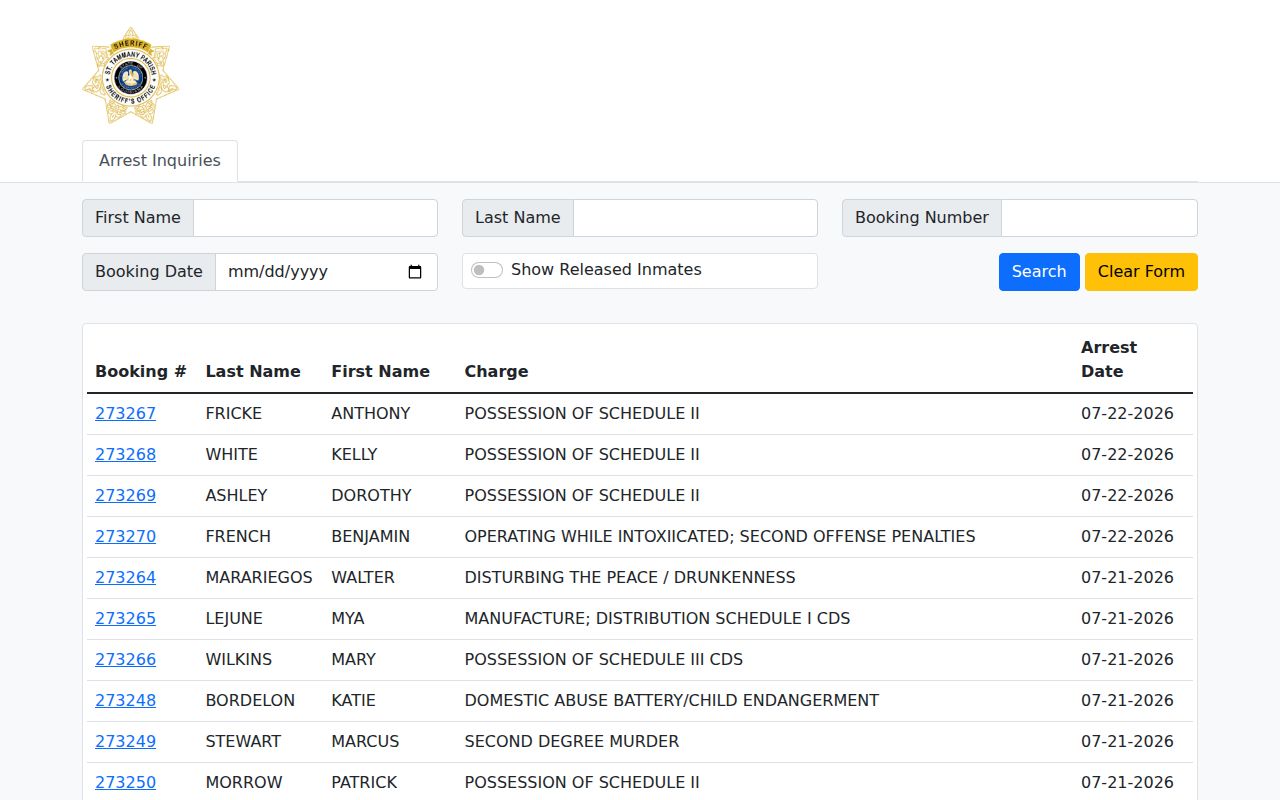
The captured official page provides the browser route that should be checked for the current release tab and photo treatment. Read the visible labels rather than assuming a field. A release timestamp does not guarantee that a release reason or destination also appears. If those facts matter, request the custody chronology and consult the court minute.
The 48-hour limit is a display period, not a destruction schedule. Louisiana’s general retention rule can require preservation for at least three years when no other law or approved schedule controls, but it is not a promise that every booking field has one fixed term. Ask the custodian what record exists. For a current recent-release view with the locally documented time limits, see Released Last 24 Hours.
Note: Roster removal can reflect an aging display, a transfer, or another custody event, so preserve the explicit release field when available.
Request a St. Tammany Booking Photo
After the release entry rolls off, submit a focused request to STPSO Criminal Records through the Public Records Center. The office identifies the custodian, accepts public-record requests, and requires payment before records are released. A precise request is easier to locate and price than a broad demand for all material about a name.
Booking Photo Records Request Steps
- Identify the person and booking. Give the full legal name, useful aliases, date of birth if known, approximate booking date, and the STPSO booking number when available.
- Name the exact item. Ask for the booking photograph from that custody event in its existing electronic format. If context is needed, separately identify the booking sheet or custody/release chronology.
- Choose the format. State whether an electronic copy is acceptable and whether certification is needed. Avoid asking for a Crime Lab print when the existing electronic booking image is the actual record sought.
- Ask for a cost estimate. Request notice before charges exceed a chosen limit. The fee schedule prices documents and images by case, page, count, media, and postage.
- Keep the tracking record. Preserve the GovQA number and written reply. If part is withheld, ask for the legal basis and any reasonably separable nonexempt portion.
The STPSO Criminal Records page shows the official request route and payment notice:
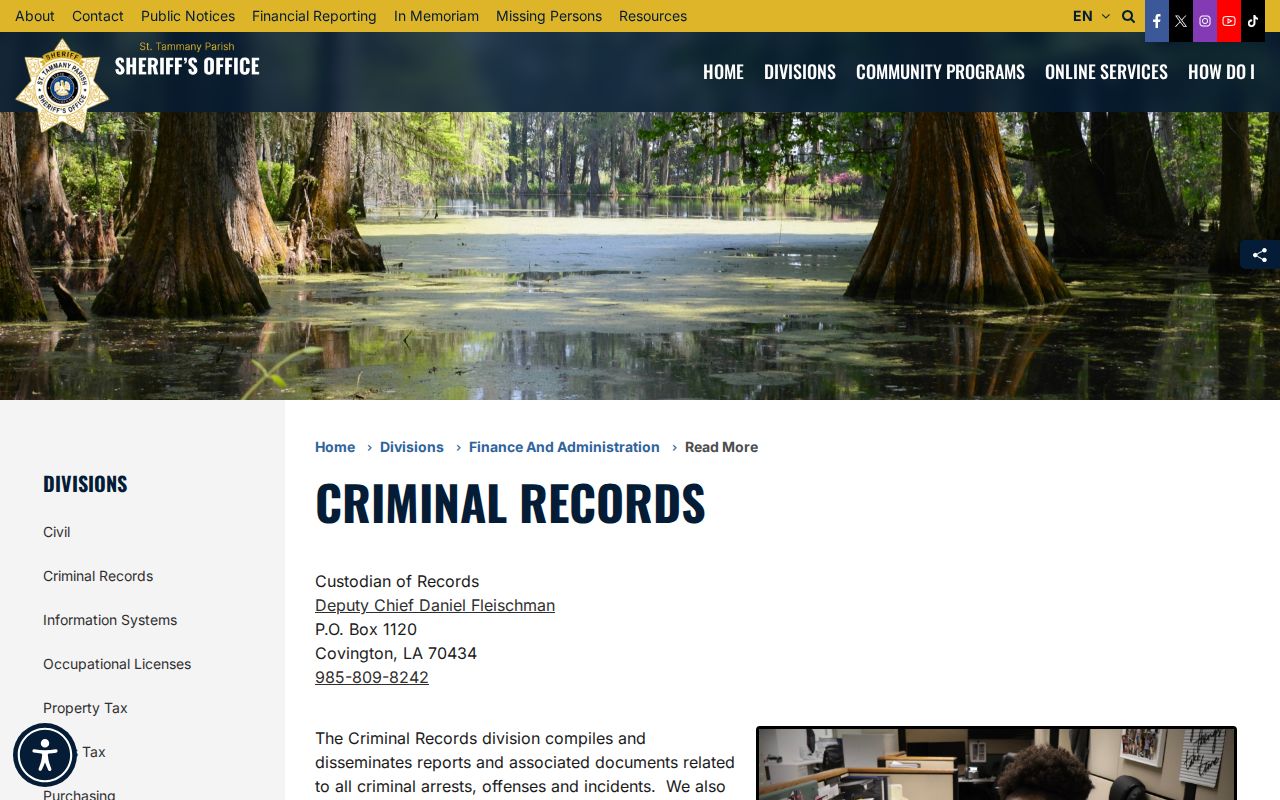
That route is used for an existing sheriff record, not for the court’s case outcome. The St. Tammany Clerk handles copies of minutes, judgments, pleas, dismissals, sentences, and other case entries. When exact release authority matters, request the jail record and the court record as separate items.
St. Tammany Mugshot Request Fees
The STPSO fee schedule effective August 1, 2024 gives a concrete fallback for photos after the public window. Electronic photos cost $15 per case for up to 20 images. Images 21 through 100 cost $0.50 each, and images 101 onward cost $0.25 each. Printed or certified Crime Lab photos are listed at $5 for a 4-by-6 print and $10 for an 8-by-10 print. Those are distinct categories.
A request for one existing booking photograph should say exactly that. Do not assume the Crime Lab print rate applies. Ask for an estimate before production, especially when a name has several bookings or a broad date range. STPSO states that payment is due before release and that prior request balances must be cleared. Fees and personnel can change, so verify the current page when filing.
Louisiana Public Records Law generally calls for access during regular office hours and a response to a written request, but it does not support a promise that every image will be produced within one fixed number of days. Search, review, exemptions, redaction, volume, and payment can affect timing. The roster photo remains fastest when it is still displayed.
St. Tammany Mugshot App Limits
STPSO has documented a Citizen App, but the official description concerns public-safety alerts and reports of suspicious or criminal activity. It may accept optional location, photo, or video information from a user. The source does not describe inmate lookup, released-person search, or a booking-photo gallery. It should not be presented as a St. Tammany Parish released mugshot app.
Use the official browser roster on a phone instead. For custody-status notifications, use Louisiana VINE after matching the correct person and reporting agency. VINE is not a certified release record or a permanent photo archive. It may help show whether the source agency reports custody, transfer, or release, but a missing result is not proof that release occurred.
This local distinction matters because sheriff apps in other places can expose jail features that their websites do not. That pattern was not established here. The official STPSO browser application, the records custodian, the Clerk, and LDPSC remain the supported St. Tammany channels.
Note: A mobile-friendly official roster is not the same as a sheriff app with a documented inmate-photo function.
Verify St. Tammany Mugshot Copies
Booking photos can persist outside the jail system. A third-party mirror may retain a copied image after the official release view ages off. Such a copy can help identify a possible booking, but it is not authoritative for the date, disposition, current custody, correction, or original source. No commercial mugshot publisher is linked or endorsed here. Match any copied image to an STPSO booking number and then confirm the record through STPSO and the Clerk.
Official news is another limited channel. The STPSO press archive and the Sheriff’s verified social accounts may publish a case-related image. These are selective public-information posts, not a full roster or release archive. A press photo may differ from the intake image, and an arrest post may remain online even after later court action.
Context guards against a false claim. A photo shows that an image was associated with a booking or public post at a point in time. It does not say that the person was convicted, that every listed charge survived, or that the person is still held. Obtain the minute or judgment for the case result and the explicit release entry for the end of STPSO custody.
St. Tammany Mugshot Removal Rules
Louisiana expungement removes qualifying arrest and conviction records, including photographs, fingerprints, and disposition information, from public access. It does not destroy the record. Code of Criminal Procedure Articles 972 and 973 define the effect and confidentiality rules. Eligibility depends on the case facts and the current statutes. A sealed or expunged matter may no longer appear in a public portal even though the underlying custody event occurred.
Louisiana Code of Criminal Procedure Article 234 supplies a narrower rule for a covered remove-for-pay publication. After qualifying proof of acquittal, nonprosecution, expungement, vacation, or pardon, the publisher must remove and destroy the booking photograph within seven calendar days and may not charge for removal. The current codified text controls. That rule is not a promise that every official record must be erased or that every publication fits the definition.
For an official source, give STPSO or the Clerk the signed order and enough identity detail to locate the correct booking or case. For a covered publisher, follow Article 234 and provide the qualifying proof specified by law. Do not pay a service merely because it claims to control an official record. When a photo is wrong or tied to the wrong person, preserve the URL and booking details, then seek a correction from the source that published it.
- Booking photograph
- An intake image tied to a specific arrest and booking event.
- Disposition
- The court’s recorded outcome or action in the case, which a photo does not establish.
- Expungement
- A legal process that removes qualifying records from public access without destroying them.
- Release record
- The jail or agency entry that states when and how its custody ended, when those fields exist.
The most reliable record set links the photo to the right booking, the booking to the court file, and the release entry to the correct custodian. Each source answers a separate question.